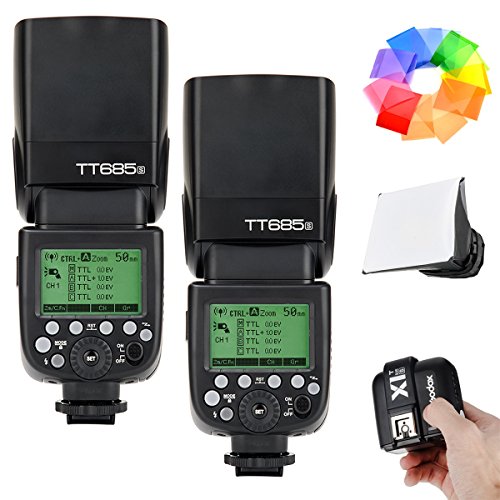
Beste 2pcs Godox TT685S Blitzgerät HSS 1/8000S GN60 TTL Kamerablitz Flash Speedlite mit X1T-S 2.4G TTL Kabellos Blitz Auslöser für Sony DSLR-Kameras mit Multi Interface Shoe A77II A7RII A7R A58 A99 ILCE6000L ILDC Camera Test
Produktbeschreibung
Godox TT685S Works ONLY for Sony Cameras with Multi Interface Shoe
Leitzahl(1/1 Ausgang bei 200 mm):60(m ISO 100)/190 (FußISO100)
Blitzabdeckung
-20 bis 200mm (14mm mit breiter Platte)
-Auto-Zoom (Blitzabdeckung wird automatisch auf die Brennweite und die Bildgröße angepasst)
-Hand Zoom
-Schwingen/Kippen des Blitzes(bouce Blitz):0 bis 360 Grad horizontal,-7 bis 90 Grad vertikal
Blitzdauer:1/300 bis 1/20000 Sekunden
Expositionsbegrenzung
Belichtungssteuerung: TTL-Autoflash und manueller Blitz
Blitzbelichtungskorrektur (FEC): Manuell. FEB:±3 Stopps in 1/3 Stufen(manuelle FEC und FEB können kombiniert werden).
Sync-Modus:Hochgeschwindigkeits-Synchronisierung (bis zu 1/8000 Sekunden), Synchronisation mit dem ersten Vorhang und Synchronisation mit dem zweiten Vorhang
Multi-Blitz:vorgesehen (bis zu 90 mal, 100Hz)
Drahtloser Blitz
Funk-Blitzfunktion: Master,Slave, Aus
Steuerbare Slave-Gruppen: Optisch (2, A und B);2.4G(3,A,Bund C)
Reichweite (ca.)
2,4G ≤ 100M
-Optische Indoor:12 bis 15m/39,4 bis 49,2ft.
-Optische im Freien:8 bis 10m/26,2 bis 32,8 ft.
-Master Einheit Empfangswinkel:±40°horizontal,±30°vetically
Kanäle: Optisch 4 (1,2,3,4);32(1-32)
Slave-Bereitschaftsanzeige:Die roten roten Blinker blinken
Autofokus-Hilfslicht
Wirksamer Bereich (ungefähr):Mitte:0.6-10m/2.0-32.8 Fuß,Peripherie: 0.6-5m/2.0-16.4 Fuß
Energieversorgung
AA-Batterien:Ni-MH-Batterien (empfohlen)oder4*LR6 Alkaline-Batterien
Wiederverwertungszeit:Approx.0.1-2.6 Sekunden
Volle Leistung blinkt:ca.230
Sync Triggering-Modus:Hotshoe, 3,5mm SyncLeitung,Wireless Control Port
Farbtemperatur:5600±200k
Paketliste
2*TT685S Blitz
1*X1T-S Sender
1*Mini stehen
1*Handbuch
1*Schutz-Fall
1*Blitz Diffuser Softbox
1*Blitz-Farben-Filter
1*Klettverschluss
1*Pergear Reinigungs Set
2pcs Godox TT685S Blitzgerät HSS 1/8000S GN60 TTL Kamerablitz Flash Speedlite mit X1T-S 2.4G TTL Kabellos Blitz Auslöser für Sony DSLR-Kameras mit Multi Interface Shoe A77II A7RII A7R A58 A99 ILCE6000L ILDC Camera Kundenrezensionen:
Kundenrezensionen
Hilfreichste Kundenrezensionen
2 von 2 Kunden fanden die folgende Rezension hilfreich.
Von Gerhard Koehler
Ich habe mir den Blitz gekauft, weil der eingebaute Blitz meiner Sony HX400V doch oft zu schwach ist. Gestern gleich ausgepackt und ausprobiert mit ca. 100 Aufnahmen. Beschreibung in Englisch, etwas dürftig. Ich dachte zuerst, mit automatischem Zoom geht nicht, in der Produktbeschreibung steht Sony DSLR. Aber, es geht. Arbeitet Top mit meiner Kamera zusammen, Zoom wird erkannt und am Blitz automatisch eingestellt. Stabile Transporthülle dabei.Wiegt mit Hülle und Batterien 570g. Über das beigefügte Zubehör für indirektes Blitzen kann ich noch nichts sagen, bleibt erstmal unberührt. Wenn die Kamera nach voreingestellter Zeit in den Ruhemodus geht, schaltet der Blitz mit ab und geht wieder mit an. Meine Meinung: Preis-Leistung TOP.
0 von 0 Kunden fanden die folgende Rezension hilfreich.
Von G. CAMPOS
Disclaimer: I’m not affiliated with any company and I paid for this product with my own money and for my own use.The Godox Wistro AD600 has been a thrill in the photographic community for the last year or so, because for a quarter of the price one can get a portable studio strobe with high speed sync (HSS - more on that later), no need to be plugged to a power supply (either a wall plug or a power pack) and, in some models, the very useful TTL function (more on that bellow). Being able to get a 600 watt/second studio light anywhere is a dream for a location photographer, especially at such low prices. But, is it worth it? Does it deliver what is promised? Let’s find out!Size: height:22 cm, width: 24.5 cm, depth:12.5 mm (8.6 x 9.65 x 4.9 in inches)Weight: 2,70 kg (almost 6 pounds) – with battery and lamp, but with no modifierNoise during operation: none, except if you set it to beep when rechargedAlthough I bought it from Amazon.de, the box came to my hands from China – in a very surprising fast shipping, by the way. No taxes were charged. The exterior box was exceptionally well packed, with layers upon layers of bubble plastic covering the actual box, which contained the flash unit itself, one lamp, one charging device to plug to the wall (100 to 240v, 50 to 60 Hz), one battery, one remote controller (my unit is for Sony cameras, but there’s also controllers to Nikon and Canon. They differ from one another by a letter on top – S, N or C – and you must be careful when buying to avoid confusion), manuals and warranty certificates. Besides that, the specific seller also packed a pair of white gloves and a “lipstick” dust remover. I have an unboxing video on you tube if you’d like to watch it – under “just review” in English and in Portuguese.This package I bought comes WITHOUT a reflector, so my measurements are all done with a bare bulb flash – I might have used one of my reflectors, but it would impact differently from what you have, so, it’s better to have apples for apples.The manuals (to the remote controller and to the flash unit) are written both in Chinese and in English – no German version – and, contrary to the norm, the English version is very well written by a native speaker as far as I can tell.The flash unit is made mostly of industrial durable plastic. The front of the unit where the lamp is attached is made of metal, as well as the modifier mount and the battery placement spot at the back. The LCD screen is placed on its right side, has a green background with black letters that are easy to read even in day light. On the left side of the unit is the moveable clip to lock/unlock the mount so you can fix a modifier to the unit. At the bottom, as usual, is the tripod mount (with a umbrella holder) and the locking mechanism to angulate the unit (from 90 degrees downwards to a bit more than 100 degrees upwards in a range of more than 180 degrees – all in tiny increments, because the mechanism is not locking except at certain distances) All in all, it’s a very compact and sturdy unit, given a very good impression of durability, EXCEPT for the locking mechanism that is all made of plastic (as far as I can tell) and squeaks a bit when hardly tighten. Godox should replace it with a metal one.My unit is equipped with a Bowens mount – plenty of inexpensive modifiers on the marked. But they have it in other mounts, if you already have many modifiers and want to use them with this unit.The AD600 has a few versions. The MANUAL one (has a M at the end of it name, as mine) and the TTL version (no letter assigned to the unit). So, if you want a BOWENS MOUNT MANUAL ONLY flash unit, you’d select the AD600 BM. If you wish the (around 30 to 40% more expensive) BOWENS MOUNT TTL AND MANUAL flash unit, you’d select the AD600 B and so on. ALL of them have HSS capabilities and all of them have VERY FAST flash durations. They also have a multistrobe function (the unit flashes many times per second), which I never use.This strobe has a modeling lamp rated at 10w (LED). It can be used in three power steps. At step 1, it’s barely useful even in a very dark studio. At step 3, at 2 meters distance (6,6 feet), at shutter speed 1/60s and ISO 3200 will get a f/1.8 as measured by my Sekonic meter WITHOUT any modifier mounted on the strobe. Very dim light, useful if in a studio setting, but completely useless if used outdoors.The AD600 can be adjusted in one third of a stop (EV) increments from 1/256 power to 1/1 power, equivalent to 600 watt seconds. Is it plenty? Or enough? Well, that, of course, will depend very much on what you need and the way you use the strobe. For a home studio is MORE than enough and you’ll find out you will use the unit at 1/64 or 1/32 most of the time (depending on your modifier). For a regular commercial studio, 600 watt seconds is plenty and enough with most modifiers, although you’ll find yourself using it more and more at 1/2 or 1/1 settings, which increase the recycling time. By the way, the unit DOES NOT work plugged to the wall outlet, only on battery, so no way to increase the number of shots per battery charge or to decrease the recycling times.I’ll have a complete review video of my unit on you tube if you’d like to watch it – under “just review” in English and in Portuguese.Some units, not mine, have also TTL capabilities. That’s very handy for those in a rush and that have not the time or the luxury to be able to take a few test shots a few times before taking the final photo. TTL means that the camera and the flash communicate (very complex stuff, better leave it alone!) and the power the strobe fires when you press the shutter is PRECISELY the amount needed to illuminate your scene. If you are familiar with Joe McNally you’ll know how TTL can make your live easier. Units with TTL capabilities are, as of now, 30 to 40% more expensive than the manual ones.Measuring the amount of power the unit delivers with a Sekonic light meter (L-758) 2 meters away (6.6 feet) at shutter 1/200s and ISO 100 WITHOUT any modifier we have: at full power (1/1): f/16; at 1/8: f/5.6; at 1/16: f/4.5; at 1/64: f/2.2 and at 1/256: f/1.1. If you move to 1 meter distance (3.3 feet) from your subject, you’ll increase all those numbers by one stop (EV), meaning that you’d have to set your camera at f/8, at 1/200s and ISO 100 with the strobe set at 1/8th power (no modifier) to get a correct exposure. Or if you want to use your expensive f/1.4 or 1.8 lens, you’d have to use the strobe at its minimum power and position the light around 1.5 meters of your subject to get the correct exposure at those wide apertures. Very powerful strobe! Most modifiers “eat up” lots of light, especially softboxes with double diffusion, so you’d have to measure with you own modifier to get your numbers correctly, but the numbers above give you a ball park to play with.What about color consistency (a VERY important matter that many photographers, especially beginners overlook)? I also don’t have a color meter, so I had to use the “old fashion way”… Well, I took 10 photos at each full setting (1/1, 1/2, 1/4 and so on) with the proper exposure (as measured by the Sekonic L-758) and with my color temperature on my Sony A7Rii set to “flash” with a Sony 70-200mm F4.0 lens at 200mm and then I analyzed them all in Lightroom. Godox claims that the AD600 will perform with a maximum variance of color of 200 degrees Kelvin. That’s NOT TRUE when analyzing all the photos together – from a 1/1 power to 1/256th power there was a variation of 350 degrees Kelvin (being the 1/256th visually warmer). BUT, considering that most photographers will NOT vary the power of their flash within the same sequence of photos (and, then, my friends, TTL users will suffer the most, because they can’t control that), meaning, after setting the flash to, say, 1/4th power, it will remain so for a long set of photos before changing it, then the variance was VERY GOOD INDEED. The most variance was at full power and, again, at 1/256th power (to a maximum of 100 degrees Kelvin, most of the time just 50 degrees K). For ALL the other power settings, the variance was of only 50 degrees K tops. What about tint? It varied only 1 point at 1/1, 1/32th, 1/64th and 1/128th. Impressive! Very impressive, Godox!High speed sync (HSS) is the ability some strobes or flashes have to function with some cameras at shutter speeds ABOVE the camera’s sync speed (usually something between 1/160 to 1/250s). If the strobe doesn’t have HSS capability and you use, for instance, a shutter of 1/300s, you’ll have a BIG black bar across your frame and an uneven flash illumination of your subject. When a strobe or flash can HSS, it will fire dozens of very fast flash bursts DURING ONE SHUTTER MOVEMENT, hence illuminating all the frame and allowing the photographer to use very high shutter speeds – up to 1/8000s in the case of the AD600 WITH THE APROPRIATE REMOTE CONTROLER. This is most useful for outdoor photography when one wants to overpower the Sun and have dark environment with very well-lit subjects at the same time.Unfortunately, I don’t have the most modern Sekonic light meter that allows to measure for HSS flashes intensity, so I’m in debt with you for that information…Well, here it’s important to understand the difference between T.05 and T.01 flash durations. If you read about most studio strobes you’ll see that manufacturers disclose the t.05 flash durations and brag a bit about it. But the t.05 flash duration is NOT the best clue you’ll have to the motion freezing power of any flash or strobe unit, and, as expected, manufacturers try very much to “cheat” us into thinking that a flash duration of 1/1.000 (t.05) is great (and most common flash units revolve around this number). It IS NOT! With this flash duration you’d get the approximate motion freezing power of a shutter around 1/200s, which is NOT enough to freeze even a couple dancing a Waltz! If you want to freeze real action, you need a t.05 of at least 1/10,000 or 1/30,000, which most don’t have. In terms of t.01, which is the REAL DEAL, you need at least 1/1,200 or 1/5,000 of a second or more, and THAT’S A MAJOR CARACTERISTIC OF THE GODOX AD600. It has a t.01 flash duration of up to 1/10,000. Great news for those photographing children running, animals, bouncing balls, sports or dripping water! (At 1/1 power it’s flash duration T.01 is 1/220; at 1/8 is 1/2350s; 1/16 is 1/3540s; 1/64 is 1/6250s and at 1/256 is 1/10,000s!!!!!). Again, my light meter doesn’t measure flash duration (only the most modern Sekonic Light meter does so - the Sekonic L-858D ), so, I must trust the information on the flash unit itself – but on my video review I’ll have a few tests with bouncing balls and fans to be sure that Godox is telling the complete truth.I’ll have a complete review video of my unit on you tube if you’d like to watch it – under “just review” in English and in Portuguese.The Godox AD600 works wirelessly with a Godox X1-T controller (mentioned above) and this controller works with up to 3 groups and 32 channels in each one – so, plenty of “space” to avoid interference from other photographers or devices around you. Besides that, the X1-T works with HSS, TTL, Manual or multiflashes modes, but, unfortunately, for reasons unbeknown to me, it stops down the unit to 1/128th power at most. If you wish to set it to 1/256th power, you’ll have to do it manually.I was able to flash the unit more than 500 times at full power before having to recharge it. Lots of juice in the 8,700mA battery! There’s a small button above the battery that shows roughly how much charged the unit still is. Except for the most avid photographer, one battery is enough, but you can buy another one if you wish to have a charged spare on hand. Important to note that even wedding photographers, known for taking up to 2,000 photos per event, will probably not need to have two batteries, because rarely they will fire the strobe at full power and I expect to squeeze up to 2,000 strobe flashes out of a single battery if used at 1/8th or 1/16th power. It takes up to 4 hours to recharge the battery depending on how much juice was left in it.[...]
0 von 0 Kunden fanden die folgende Rezension hilfreich.
Von Roman Pohl
Superschnelle Lieferung innerhalb 48 Stunden. Verwende sie an einer Sony Alpha 77 II sowie Alpha 99 II. Hatte aber bisher noch nicht die Zeit sie ausführlicher zu testen, aber alle Features funktionieren ohne Probleme. Angesichts der Austattung bzw. dem Funktionsvielfalt wie TTL, HSS, Funksteuerung und der Blitzleistung ist der Preis ein Schnäppchen, verglichen mit den bekannten europäischen Marken. Zudem ist jedem Biltz eine - wenn auch einfache - Mini Softbox (Diffusor), ein Folienhalter inklusive Farbfolien! sowie ein Reinigungsset bestehend aus Microfasertuch, weissen und gummierten Stoffhandschuhen und ein Reinigungspinsel beigelegt. Bei vielen der teuren Markenprodukten ist nicht mal der Blitzstandfuß inklusive. Zum Wermutstropfen. Die Menüführung sowohl des Blitzes als auch des Senders ist gewöhnungsbedürftig und benötigt Einarbeitung.Aber kein Grund einen Stern abzuziehen, da sich das nach einiger Zeit erledigt hat. Würde ich wieder kaufen. Daumen hoch!